Why vents and flashing cause so many leaks
A roof is a continuous surface until something breaks through it. Every plumbing vent, exhaust fan, furnace flue, turbine, skylight and chimney is a hole, and every place the roof meets a wall is a seam. Flashing and boots seal those openings. They are small, they take the brunt of sun, heat and hail, and they often fail long before the shingles around them.
Parts that fail and how they fail
Pipe boots
The rubber collar around a plumbing vent dries, shrinks and cracks under the strong South Plains sun. Water runs down the pipe and into the attic. Hail can also split them. Replacing cracked boots is one of the most frequent roof repairs in the area.
Exhaust vents and turbines
Metal and plastic vents dent or crack in hail. Turbine vents can seize, wobble or have their fins bent, and if the base loosens, water gets around it.
Wall and chimney flashing
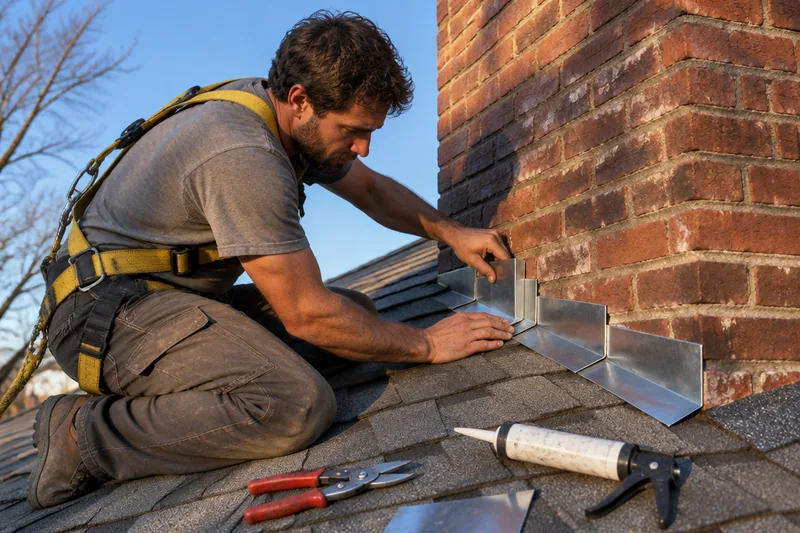
Step flashing along walls and counter flashing on chimneys can loosen as sealant ages or mortar cracks. Water then runs behind the flashing.
Skylights
Skylight domes can shatter in hail, and the flashing kit around the frame can leak if it was installed with sealant instead of proper flashing.
How these repairs are done
The roofer lifts the shingles around the penetration, removes the old boot, vent or flashing, and installs a new one so that the upper shingles overlap it and water sheds over the top. Sealant is used to supplement flashing, not replace it. For walls, step flashing is woven in with each course of shingles, and counter flashing is set into the masonry or covered by siding. Turbines may be replaced with new turbines or static vents depending on the attic's ventilation needs.
| Part | Common failure | Typical repair |
|---|---|---|
| Pipe boot | Cracked rubber collar | Replace boot, reseat shingles |
| Exhaust vent | Hail-dented or cracked | Replace vent |
| Turbine vent | Seized, bent or loose base | Replace turbine or convert to static vent |
| Chimney flashing | Loose counter flashing, cracked mortar | Reflash and reseal |
| Skylight | Broken dome, leaking frame | Replace dome or reflash unit |
Ventilation matters too
Attic ventilation lets heat and moisture escape. In Lubbock summers, a poorly vented attic gets very hot, which can shorten shingle life and raise cooling costs. In winter, poor ventilation can cause condensation that drips like a leak. When vents are replaced, it is a good time to check that the attic has balanced intake at the eaves and exhaust near the ridge.
What affects the cost and time?
The number of penetrations, whether the surrounding shingles are brittle, whether decking under the vent has rotted, chimney condition, and roof pitch all matter. A single pipe boot on a walkable roof is a modest job; reflashing a chimney with cracked mortar is a larger one.
Before the roofer arrives
Look in the attic around each pipe and vent for stains or wet insulation and note which ones are wet. Check skylights for cracks from below. Photograph any stains on ceilings near chimneys or walls.
When is it urgent?
A shattered skylight or a vent knocked off by wind leaves an open hole and should be covered immediately. A cracked pipe boot that drips during rain should be fixed before the next storm so the decking under it does not rot.
Frequently asked questions
How do I know if my pipe boot is leaking?
Look in the attic around the plumbing vent pipe for stains, wet insulation or daylight. From the ground, binoculars may show a cracked or split rubber collar.
Can flashing be sealed with caulk instead of replaced?
Sealant can help in some places, but it is not a substitute for flashing. Caulk alone cracks in sun and heat and usually leaks again.
Should I replace turbine vents?
If they are seized, bent or leaking at the base, replacing them or switching to static vents may be sensible. The choice depends on your attic's ventilation needs.
Why does my chimney leak only in heavy rain?
Wind-driven rain can get behind loose counter flashing or through cracked mortar and brick. Reflashing and repairing the masonry usually solves it.
Can hail damage roof vents?
Yes. Metal vents dent and plastic vents crack in hail, and dents on vents are one of the clues roofers use to confirm hail size.