Why hail damage is easy to miss
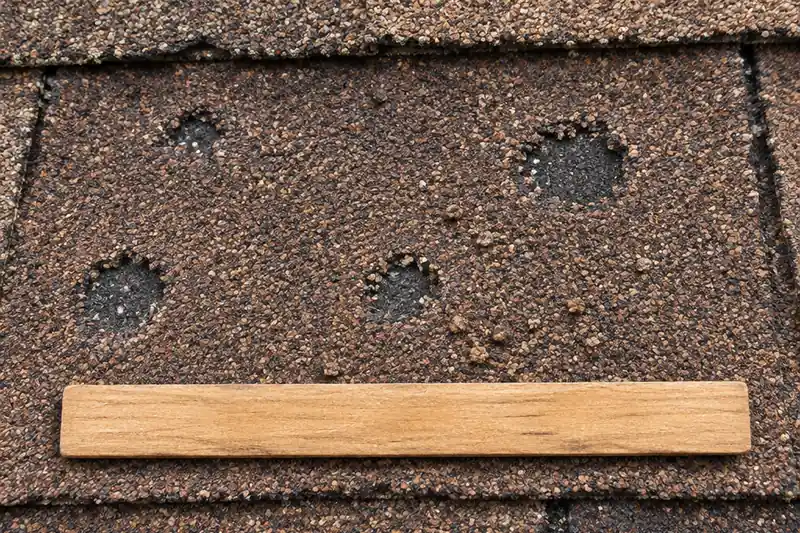
Most hail damage cannot be seen from the yard. A hailstone that strikes an asphalt shingle knocks off a patch of the mineral granules that protect the asphalt, sometimes cracking the shingle's fiberglass mat underneath. From the ground, the roof looks the same as it did the day before. The trouble shows up later: exposed asphalt breaks down in sunlight, the bruise spreads, and months afterward water finds a way in.
That delay is why hail matters so much on the South Plains. Lubbock sits at about 3,200 feet, and spring storms here can produce large hail. Peak hail season in Lubbock tends to arrive around mid to late April and continues into early summer. The National Weather Service office in Lubbock has documented large hail inside the city, including near 93rd Street and Slide Avenue in May 2020 and from a supercell in June 2023, and giant hail in nearby Hockley County in May 2024.
Start on the ground: the clues around your house
You can learn a lot without climbing a ladder. Soft metals and painted surfaces record hail just as the roof does.
- Air conditioner fins. Dents in the thin aluminum fins of the outdoor unit are one of the clearest signs of hail.
- Gutters and downspouts. Look for round dents along the top edge and face.
- Window screens and wraps. Torn screens and dented aluminum trim.
- Mailboxes, light fixtures, vehicles. Fresh dents with clean edges.
- Granules at downspouts. A pile of dark sand at the bottom of a downspout after a storm means shingles are shedding granules.
- Siding and fences. Spatter marks, where hail cleaned off dirt or oxidation, show direction and size.
Note which sides of the house were hit. Hail usually arrives with the wind, so the slopes facing the storm take most of the damage.
Signs of hail damage on asphalt shingles
Bruises and granule loss
The classic hail mark is a roughly round spot where granules are missing, exposing darker asphalt. Fresh hits often look shiny or black. Pressing a hit may reveal a soft spot that feels different from the surrounding shingle, which suggests the mat underneath is fractured.
Cracks and fractures
On older, sun-dried shingles, hail can crack the shingle outright. Cracks may radiate from the point of impact. Ridge caps, which are bent over the peak, crack especially easily.
Random pattern
Hail hits fall randomly across a slope. Marks that line up in rows or appear only in certain spots are more likely to be manufacturing or installation issues than hail.
Signs of hail damage on other roof parts
- Metal vents and flashing: round dents on turbines, exhaust caps and flashing.
- Plastic vents: cracks and holes.
- Skylights: crazed, cracked or shattered domes.
- Pipe boots: split rubber collars.
- Metal roofs: dents in panels, cracked paint or coatings, and in severe storms, punctures or opened seams.
- Flat and foam roofs: pocks in the coating and crushed foam.
Hail damage or normal wear? How to tell them apart
| What you see | Hail damage | Look-alike |
|---|---|---|
| Dark round spots | Random spread, often with a soft center | Blistering: raised bubbles that pop, usually in clusters on hot slopes |
| Missing granules | Spot-shaped, at the impact point | Normal aging: even thinning across the whole roof |
| Marks in a pattern | Not typical | Foot traffic, tools or manufacturing marks |
| Cracks | Radiate from an impact point | Thermal cracking: long splits on aged shingles |
| Dents on metal nearby | Usually present | Absent |
Insurers and roofers often distinguish between functional damage, which affects the roof's ability to shed water or shortens its life, and cosmetic damage, which only changes how it looks. That distinction matters for claims, especially on metal roofs, so read your policy.
How roofers inspect for hail
A roofer typically walks each slope and marks hail hits with chalk inside a test square, often ten by ten feet. Photographs of each marked square, together with photos of dented vents and soft metals, create a record of the damage. They also check the attic for daylight and water. Ask for copies of all the photos; they are your record of the roof's condition after the storm.
What to do after a hailstorm
- Stay safe. Do not climb onto a wet or hail-covered roof.
- Document. Photograph hailstones next to a ruler or coin, and the dents around the house, with dates.
- Check inside. Look at ceilings and in the attic for water.
- Book an inspection. Within a few days is sensible, while damage is fresh.
- Read your policy. Check your deductible and how to report a claim, and report promptly if you plan to claim.
- Be wary of pressure. In Texas, no contractor may waive, pay or absorb your deductible, and a roofer doing the repair may not act as your public adjuster.
When hail damage becomes urgent
Call immediately if hail has broken through the roof, shattered a skylight, or water is coming in. Those openings need a temporary cover before the next rain. If there is no visible leak, schedule an inspection rather than waiting; the longer bruised shingles bake in the sun, the more likely they are to leak.
If you see signs of hail damage on your roof, our hail damage roof repair page explains how repairs are made, and you can call any time to reach a local roofer.
Frequently asked questions
Can you see hail damage on a roof from the ground?
Sometimes, but usually not. Bruises and lost granules are hard to see from below. Dents on gutters, vents and the air conditioner are easier clues that the roof was hit.
Does hail damage always cause a leak right away?
No. Many hits only remove granules at first. The exposed asphalt breaks down over months, and leaks appear later.
What is the difference between functional and cosmetic hail damage?
Functional damage affects how well the roof sheds water or how long it will last. Cosmetic damage changes only the appearance. Policies may treat them differently, especially for metal roofs.
How big does hail have to be to damage shingles?
Hail around one inch and larger commonly damages shingles, but older, brittle shingles can be damaged by smaller stones, and wind-driven hail does more harm.
Should I get my roof inspected even if I see no damage?
After a storm that dented gutters, vents or vehicles nearby, an inspection is worthwhile. Hidden damage is common.