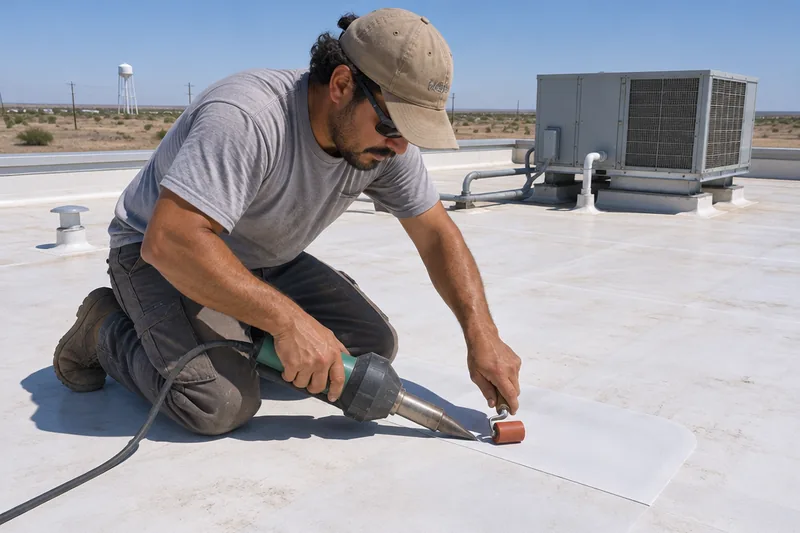
Flat roofs on the South Plains
Low-slope roofs are everywhere in Lubbock: on strip centers, offices, churches and schools, and on many homes with additions, porches and carports. Some older homes in the area also have flat or nearly flat roofs. Spray polyurethane foam has a long history in West Texas because it insulates well in heat, and single-ply membranes like TPO are common on newer commercial buildings.
Flat roofs leak differently from pitched roofs. Water moves slowly across them, so any weak point that sits in water for hours after a storm is more likely to let it through.
Common flat roof problems
- Open seams. Membrane seams that were not fully welded or have pulled apart with movement.
- Punctures. From hail, foot traffic, dropped tools or equipment work.
- Ponding. Water standing for more than a day or two after rain, usually from sagging decking or blocked drains.
- Blisters and splits. On built-up and modified bitumen roofs, trapped moisture and heat cause blisters that eventually crack.
- Worn coatings. Foam roofs rely on a coating to protect the foam from sun. Once it wears through, the foam degrades.
- Flashing at walls and curbs. Where the roof meets parapets, HVAC curbs and pipes.
How flat roofs are repaired
TPO and other single-ply
Open seams and punctures are cleaned and repaired with a patch of the same membrane, heat-welded in place. Welds are probed to confirm they are sealed.
Modified bitumen and built-up
Blisters are cut out, the area dried, and new plies or a cap sheet patch installed. Cracked flashing at walls is replaced.
Spray foam
Damaged foam is cut back, new foam applied, and the area recoated. When the coating is worn across the roof, a full recoat may protect the foam for years if the foam itself is still sound and dry.
Drains and ponding
Drains and scuppers are cleared. Persistent ponding may need tapered insulation, crickets or decking repairs to move water off the roof.
| System | Typical repair | Watch for |
|---|---|---|
| TPO / single-ply | Heat-welded patch | Seam separation, punctures |
| Modified bitumen | Cut out and patch plies | Blisters, cracked flashing |
| Built-up (tar and gravel) | Patch plies, redistribute gravel | Blisters, bare spots |
| Spray polyurethane foam | Cut out, refoam, recoat | Worn coating, hail pocks, wet foam |
What affects the cost and time?
The type of system, the size and number of repairs, access to the roof, whether the insulation underneath is wet, and how much ponding needs correcting all matter. Wet insulation is the hidden cost on flat roofs; if a leak has run for a long time, saturated insulation may need cutting out and replacing. Infrared or core testing can help find wet areas.
Before the roofer arrives
Note where water appears inside, and whether it appears during the rain or hours later, which can indicate how far it is traveling. Move stock, equipment or furniture away from leaks. For commercial buildings, have roof access keys and any roof warranty paperwork ready, since some warranties require specific contractors or procedures.
When is it urgent?
A flat roof leak is urgent when water is reaching electrical equipment, inventory or ceilings that are sagging, or when a storm has torn the membrane. Ponding over a large area is also a load concern and should be checked soon. Small seam leaks in dry weather can be scheduled, but should be fixed before the next storm.
Frequently asked questions
Is water standing on my flat roof a problem?
Water that drains within a day or two after rain is normal for many low-slope roofs. Water standing longer than that speeds wear and adds weight, and should be checked.
Can a flat roof be repaired, or does it need replacing?
Many flat roof problems are repairable. Replacement is usually considered when the membrane is failing across the roof or the insulation underneath is widely saturated.
Does hail damage foam roofs?
Hail can pock the coating and crush the foam surface. Those spots need to be recoated or repaired so sun and water do not degrade the foam.
How often should a foam roof be recoated?
It depends on the coating and exposure. Regular inspections show when the coating is wearing thin so it can be recoated before the foam is damaged.
Can you repair a TPO roof in cold weather?
Heat welding can be done in a range of temperatures, but wet or frosty conditions can delay work. A roofer can advise on timing.