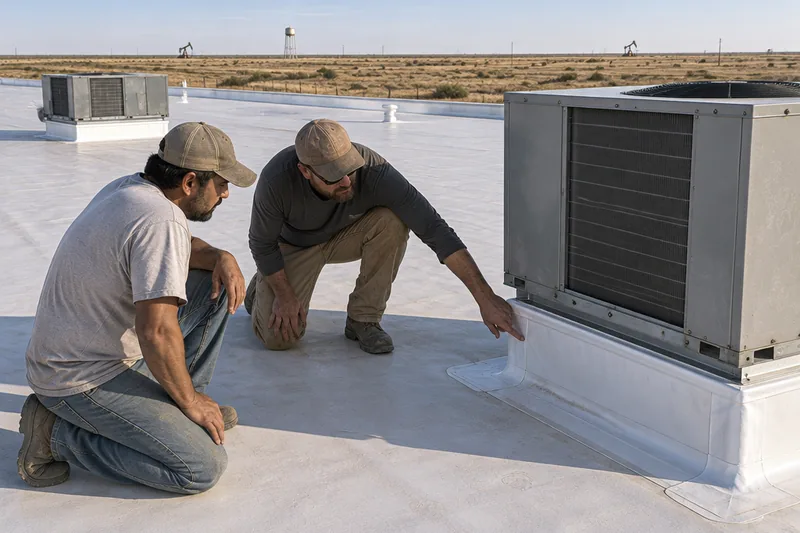
Commercial roofs in Lubbock
Lubbock's commercial buildings range from strip centers and medical offices along the main corridors to churches, schools, warehouses and cotton industry buildings at the edge of town and in the surrounding counties. Most have low-slope roofs: TPO and other single-ply membranes, modified bitumen, built-up roofs, or spray foam. Many agricultural and industrial buildings have metal roofs. Each system has its own repair methods, and the right fix depends on knowing which one you have.
What commercial roof repair covers
- Leak tracing and repair on membranes, foam and metal.
- Hail and wind damage repair and documentation.
- Flashing at parapet walls, HVAC curbs, pipes and rooftop equipment.
- Drain, scupper and gutter repair to stop ponding.
- Coating and recoating of foam and metal roofs.
- Emergency temporary repairs after storms.
Why rooftop equipment causes leaks
Air conditioning units, exhaust fans and other equipment sit on curbs that pierce the roof. Every service visit means people walking around them, dropping screws and dragging hoses. Over time the flashing around these curbs is one of the most common leak points on commercial roofs. Walkway pads around equipment and a regular check of curb flashing prevent many of these leaks.
How commercial repairs are handled
Inspection and moisture check
The roofer walks the roof, checks seams, flashing, drains and penetrations, and looks for wet insulation. On larger roofs, infrared scanning or core cuts help map where water has spread.
Scope and scheduling
Repairs are scoped and scheduled to limit disruption to tenants and customers. Noisy work or work with strong odors, such as some adhesives, can be timed for off hours.
Repair and records
Repairs are made with materials compatible with the existing system so they do not void a manufacturer's warranty. Photos and notes of each repair help with future maintenance and with insurance.
| Reactive repair | Planned maintenance | |
|---|---|---|
| Trigger | A leak or storm | A schedule, often spring and fall |
| Focus | Stop the current problem | Find problems before they leak |
| Disruption | Often during business hours | Planned around operations |
| Records | Usually limited | A running history of the roof |
What affects the cost and time?
Roof size and height, the system type, how much insulation is wet, access (roof hatch, ladder or lift), safety requirements, and whether work must happen outside business hours all affect scope. Warranty terms may require specific materials or certified installers. A large storm affecting many buildings at once also affects scheduling.
Hail on commercial roofs
Large flat roofs collect a lot of hail in a single storm. On single-ply membranes, hail can bruise the membrane over soft insulation or crack it in cold weather. On foam roofs it pocks the coating, and on metal it dents panels and can open seams. Because commercial roofs are rarely seen from the ground, a walk-through after any significant hail is worth scheduling, with photos of each area and of rooftop equipment, which also dents and can hide flashing damage. Insurance policies for commercial property often have their own deductibles and reporting rules, so check yours after a storm.
Before the roofer arrives
Gather any roof warranty documents and past repair records, and note the dates and locations of leaks. Arrange roof access and let tenants know a crew will be on site. Protect inventory and equipment under active leaks.
When is it urgent?
Water entering near electrical panels, server rooms, inventory or occupied spaces is urgent. So is storm damage that has opened the membrane, and heavy ponding that could stress the structure. Call right away. Small leaks in dry weather can be scheduled, but should be repaired before the next storm.
Frequently asked questions
Will a repair void my commercial roof warranty?
It can if incompatible materials or methods are used. Check your warranty terms and share them with the roofer before work begins.
How often should a commercial roof be inspected?
Many owners have low-slope roofs inspected in spring and fall, and after any significant hail or wind storm.
Can repairs be done outside business hours?
Often, yes, depending on the provider and the work. Ask when you call so the work can be planned around your operations.
What is the most common commercial roof leak?
Flashing around rooftop equipment, pipes and walls is among the most common sources, along with seams and clogged drains.
Can you repair metal roofs on agricultural buildings?
Yes. Fastener, panel, trim and coating repairs on barns, shops and ag buildings are part of commercial roof work.